Brazilian Jiu-Jitsu has only existed as a global sport for about three decades, but in that short time it has been completely reshaped, more than once, by a handful of athletes who came along at exactly the right moment. Each decade has its own "meta," its own rule set, its own obsession (vale tudo credibility, IBJJF medal counts, ADCC supremacy, super-fights), and each one produced a competitor (or two) who defined it.
This is a tour through that history: not an exhaustive list of every champion, but a look at the athletes whose influence reached beyond their own medals and actually changed how the sport is trained, taught, and watched.
The 1990s: Royce and Rickson Gracie prove the concept
Before the 1990s, jiu-jitsu was a regional curiosity, dominant in Brazilian vale tudo circles but unknown almost everywhere else. Two members of the same family changed that almost single-handedly.
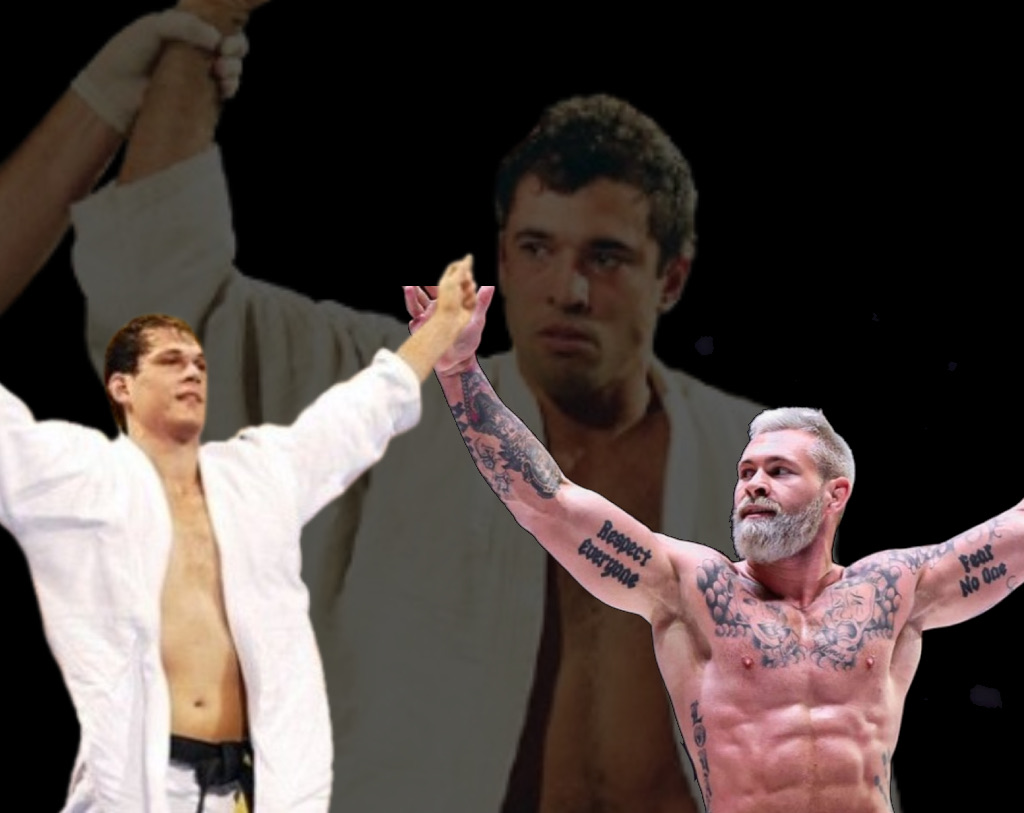
Royce Gracie was, by his own family's admission, one of the less physically imposing Gracies, which made him the perfect proof of concept. At UFC 1 in 1993, Royce defeated three opponents in a single night, none of them grapplers, to win the tournament. He went on to win two more of the promotion's first four events. For a worldwide television audience that had never seen a smaller man calmly choke out a much larger one, this was the entire pitch for BJJ in a single highlight reel. Royce didn't just win fights; he created the market.
Rickson Gracie, Royce's older half-brother, did the same job for a different audience. Rather than entering the fledgling UFC, Rickson built his legend in Japan, headlining Vale Tudo Japan events in 1994 and 1995 and later the first Pride events against Nobuhiko Takada, in front of tens of thousands of fans. Rickson never lost a recorded professional fight, and to this day competitors like Ricardo Arona and Demian Maia point to him as the standard for what jiu-jitsu, applied with total precision, can do against any style.
Between them, Royce and Rickson turned "Brazilian Jiu-Jitsu" from a family secret into a phrase every martial arts gym in the world needed to have an opinion about.
The 2000s: Roger Gracie and Marcelo Garcia define sport jiu-jitsu
Once BJJ's effectiveness was established, the 2000s were about something different: turning it into a sport with its own rules, its own circuit (the IBJJF World Championships and ADCC), and its own legends who never needed to set foot in a cage.
Roger Gracie became, for much of this decade, the closest thing the sport had to an unbeatable force in the gi. A year after earning his black belt in 2004, he competed at ADCC and won gold in both his weight class and the absolute division, submitting all eight opponents he faced. He went on to collect multiple IBJJF World Championship titles built almost entirely around two techniques: the cross-collar choke from mount and the cross-choke from the back. Roger's influence wasn't stylistic flash, it was a demonstration that flawless fundamentals, executed with enough precision, beat almost everything.
Marcelo Garcia was Roger's opposite in size and approach, and arguably even more influential long-term. Competing from 2003 until his retirement in 2011, Marcelo won his weight class at ADCC four separate times across nearly a decade, on top of five IBJJF World Championship titles. He was frequently the smallest man in the room, including in absolute divisions against opponents 18+ kg (40+ lbs) heavier, and won anyway, popularizing guard styles (the butterfly guard, the X-guard) and back-take systems that are now staples of every modern curriculum. A huge share of the guard retention and back control concepts taught in gyms today trace directly back to Marcelo's game.
The 2010s: Buchecha, the Mendes brothers, and the academy era
If the 2000s were about individual legends, the 2010s were about super-teams: Atos, Alliance, and Checkmat producing waves of black belts who turned IBJJF Worlds and the Pan Ams into a genuine arms race.
Marcus "Buchecha" Almeida is the defining figure of this decade. After receiving his black belt in 2010, he went on to become a 13-time IBJJF World Champion across multiple weight classes and the absolute division, while also winning ADCC gold in 2013. Buchecha combined a heavyweight's frame with a lightweight's guard game and an absurd motor, and for several years he was simply the best competitor in the sport regardless of opponent size, a rare combination that hadn't been seen since Roger Gracie.
Rafael Mendes, alongside his brother Guilherme, represented the other major trend of the decade: the rise of the super-academy. As a six-time black belt world champion and co-founder of Art of Jiu-Jitsu (AOJ) in California, Rafael helped export the high-level Brazilian competition system to the United States, training a generation of American competitors and shifting where the sport's center of gravity sat.
Andre Galvão, founder of Atos Jiu-Jitsu, was the connecting thread for much of the decade, both as a multiple-time ADCC and World champion himself and as the coach behind some of the era's most dominant competitors. His academy's systematic approach to building competitors became a blueprint that other teams openly copied.
The 2020s: Gordon Ryan and the no-gi takeover
The current decade has been defined by a shift in what "winning" even means. ADCC, once a biennial side event compared to the IBJJF Worlds, became the sport's true main event, and a new generation of no-gi specialists, many trained outside the traditional Brazilian academy system, took over.
Gordon Ryan is the singular figure of this era. A seven-time ADCC World Champion across four different weight categories (66kg, 88kg, 99kg, +99kg) plus the absolute division, Ryan built a no-gi record that, as of his most recent ADCC title, sits at roughly 96 wins against just 5 losses, with an 82% submission rate and no defeat since 2018. His leg lock systems and back-take sequences have been reverse-engineered by entire teams, and his willingness to call out and accept super-fights against legends like Andre Galvão turned individual matches into pay-per-view events, something almost unheard of in grappling before him.
Mikey Musumeci represents the other major story of the decade: the IBJJF gi specialist who successfully crossed over into the no-gi and promotional spotlight. A multiple-time IBJJF World Champion who became the first-ever ONE Championship Submission Grappling World Champion, Musumeci has been central to the sport's biggest recent shift, organizations like the UFC and ONE Championship signing dedicated grappling stars the way they sign fighters.
Kade Ruotolo, alongside his twin brother Tye, has been the face of BJJ's youth movement. At just 19 years old, Kade became the youngest-ever ADCC World Champion, submitting every opponent he faced on the way to gold, an outcome no other champion that year managed to replicate. The Ruotolo brothers' aggressive, finish-or-bust style has become a template for the next wave of competitors coming up through no-gi-focused academies rather than traditional gi competition.
What the decades have in common
Looking across thirty years, the throughline isn't really about who was "the best," it's about who changed what the rest of the sport had to learn. Royce and Rickson proved jiu-jitsu worked. Roger and Marcelo proved it could be a sport in its own right, with its own technical language. Buchecha and the Mendes brothers proved it could be systematized and exported at scale. And Gordon Ryan, Mikey Musumeci, and the Ruotolo brothers are currently proving it can be must-watch entertainment with its own stars, its own rivalries, and its own pay-per-views.
If you're drilling techniques today, whether it's a cross-collar choke, a butterfly guard sweep, or a leg lock entry, there's a good chance the version you're learning was popularized, refined, or made famous by one of the athletes above. Studying why a technique works is useful. Knowing who made it famous, and what era of the sport they were answering, makes the history of jiu-jitsu a lot more interesting to follow.
It's also worth noticing how many of these legacies map onto physical build: Roger Gracie's pressure game suited a big, strong frame, while Marcelo Garcia's scrambles and butterfly guard suited a much smaller one. See How Your Body Type Should Shape Your BJJ Game for more on building a game around your own build rather than someone else's.
Sources: Royce Gracie (Wikipedia), Rickson Gracie (Wikipedia), Marcelo Garcia, The ADCC GOAT (Elite Sports), Roger Gracie (BJJ Heroes), Marcus Almeida "Buchecha" - 13 Times IBJJF World Champion (Elite Sports), Marcus "Buchecha" Almeida (BJJ Heroes), Gordon Ryan (Wikipedia), Kade Ruotolo's Historic ADCC Win (ONE Championship).