Walk into any BJJ academy and you'll see a 1.63 m (5'4") powerlifter-built blue belt smashing through guards with pure pressure, and a 1.93 m (6'4") beanpole in the next round tying up a bigger opponent in a web of spider guard hooks. Neither is playing "wrong" jiu-jitsu. They're playing the jiu-jitsu their body is built for.
There is no single best body type for BJJ. Roger Gracie was tall and heavy and dominated with fundamentals; Marcelo Garcia was undersized and out-scrambled people twice his weight; Leandro Lo built one of the most dangerous guards in the sport's history off his long, athletic frame. What matters isn't the raw material, it's whether your game plan works with your build instead of against it. Here's how the major body-type traits in grappling, limb length, height, weight and strength, and flexibility, tend to map onto a game that fits.
Long limbs: leverage over strength
If you've got long arms and legs relative to your torso, you have a built-in mechanical advantage for anything that isolates a joint at a distance. Triangles, armbars, and omoplatas all work by trapping a limb and applying leverage over a longer lever arm, which means less strength and more distance is required to finish them. The same length lets you keep opponents further away in the first place.
That's why long-limbed grapplers gravitate toward guards that live at range: spider guard, De La Riva, lasso, and reverse De La Riva all use your legs to control an opponent's arms or posture from a couple of meters away, something a shorter-legged player physically can't replicate. Keenan Cornelius and Leandro Lo, both notably tall and long-limbed, built their reputations almost entirely around this kind of guard: control the grips, control the distance, and let your legs do the passing opponent's work for them.
If this is you: prioritize spider guard, De La Riva, and triangle/omoplata finishes. On top, leg drags and Torreando passes use your reach to keep the pass moving before your opponent can close distance.
Short and stocky: pressure over distance
A lower center of gravity and a compact frame are a disadvantage at range but a serious advantage up close. You're harder to sweep, harder to put on your back, and your strength-to-limb-length ratio makes pressure passing and top control efficient in a way it isn't for longer, leaner builds.
This is also where a wrestling background pays off fastest: relentless top pressure, heavy over/under and knee-slice passes, and staying glued to an opponent's hips rather than fighting them from a distance. Short, stocky grapplers tend to do better with closed guard and half guard underhook control on bottom than with leg-based open guards, and their submission game tends to cluster around tight, close-range finishes, guillotines, kimuras, and Americanas, where their compact frame lets them apply maximum pressure without needing much space.
If this is you: build your top game around wrestling entries and pressure passing, and treat closed guard with underhook control as your default bottom position rather than leaning on open guard.
Heavy and strong: methodical control
Extra weight and raw strength are an advantage almost everywhere in BJJ except one place: getting away with sloppy technique against someone who also outweighs you. Used well, weight is a passing tool (it's simply harder to sweep or reverse someone who is heavier and knows how to distribute that weight correctly) and a control tool once on top.
Roger Gracie is the clearest historical example: a big, strong grappler who won a decade of titles almost entirely on mount control and the cross-collar choke, rarely needing anything flashier. Buchecha took it further, combining a heavyweight's frame with guard retention skills usually associated with much smaller competitors, proof that size is a multiplier on good technique, not a replacement for it.
If this is you: don't rely on strength to escape bad positions early in your career, it will stop working against better technicians as you move up in level. Instead, build a top game around heavy pressure passing and mount/side control retention, where your weight does the most uncontested work.
Light and fast: scrambles and motion
If you're on the smaller or lighter end, particularly against training partners who outweigh you, standing still and trying to match strength is a losing plan. Speed, scramble ability, and guard retention become your core tools instead.
Marcelo Garcia is the template here: routinely the smallest competitor in the room, including in absolute divisions against opponents 18+ kg (40+ lbs) heavier, and still one of the most dominant grapplers of his era. His game was built around butterfly guard, constant hip movement, and back-takes off scrambles rather than ever settling into a static, strength-based battle. Smaller, faster grapplers tend to do best treating every stalemate as an opportunity to scramble to a better position rather than trying to out-muscle their way out.
If this is you: invest heavily in butterfly guard, hip escapes, and back-take entries from scrambles. Speed evens out a size disadvantage far more effectively than strength does.
Flexible or hypermobile: more options, more caution
Good hip and shoulder mobility opens up guards that are mechanically inaccessible to stiffer athletes: rubber guard, deep spider and De La Riva variations, and tighter triangle and omoplata setups all demand a real range of hip flexion, adduction, and external rotation. If you've always been the "double-jointed" one in the room, this is a genuine technical advantage.
It comes with a real caveat, though. There's a difference between flexibility (how far a joint moves passively) and mobility (how far you can move it under your own muscular control), and hypermobile joints are frequently more flexible than they are stable. That mismatch is exactly why hypermobile grapplers report both excellent guard results and a higher rate of joint injuries: the ligaments allow the range, but there isn't always enough active muscular control backing it up. Building strength through your full range of motion, not just chasing more flexibility, is what makes this trait an asset instead of a liability.
If this is you: lean into rubber guard, deep triangle and omoplata setups, but pair that flexibility work with strength training through the same ranges so your joints are supported, not just loose.
Your body type is a starting point, not a ceiling
None of this is deterministic. John Danaher, who has coached world champions across every conceivable body type, has made the point directly: the key isn't your natural physique, it's what you build with it. Plenty of tall grapplers develop excellent pressure-passing games, and plenty of shorter athletes become dangerous from the guard. Use your build to decide where to focus your early development, the guards, passes, and submissions that will click fastest and reward drilling time soonest, not as a permanent limit on what you're allowed to get good at.
Once you know which traits describe you, the fastest way to actually build the game around them is repetition, not more research. Log the specific guards, passes, and submissions you're drilling in DrillBuddy so you can see whether you're actually spending your mat time on the techniques that fit your body, or just drilling whatever the last YouTube video happened to show.
For more on building a game plan once you know your strengths, see Why Drilling Beats Rolling for Beginners and BJJ Guard Passing for Beginners. And if you want the historical version of this same idea, The Most Influential BJJ Athletes of Every Decade covers several of the athletes mentioned above in more depth.
Sources: 9 Ways to Customize Your Jiu-Jitsu Game to Better Fit Your Body Type (Atomic Jiu-Jitsu), Best Body Types for BJJ: Strengths, Weaknesses & Strategy (Novakik BJJ), The Best Moves For Tall & Lanky Grappling Athletes (BJJ Eastern Europe), Finding The Right Jiu-Jitsu Game For Your Body Type & Personality (BJJ Eastern Europe), Is There A Best Body Type For BJJ? (BJJ Fanatics), Do I Have To Be Extremely Flexible To Have Success with the Rubber Guard? (BJJ Eastern Europe).
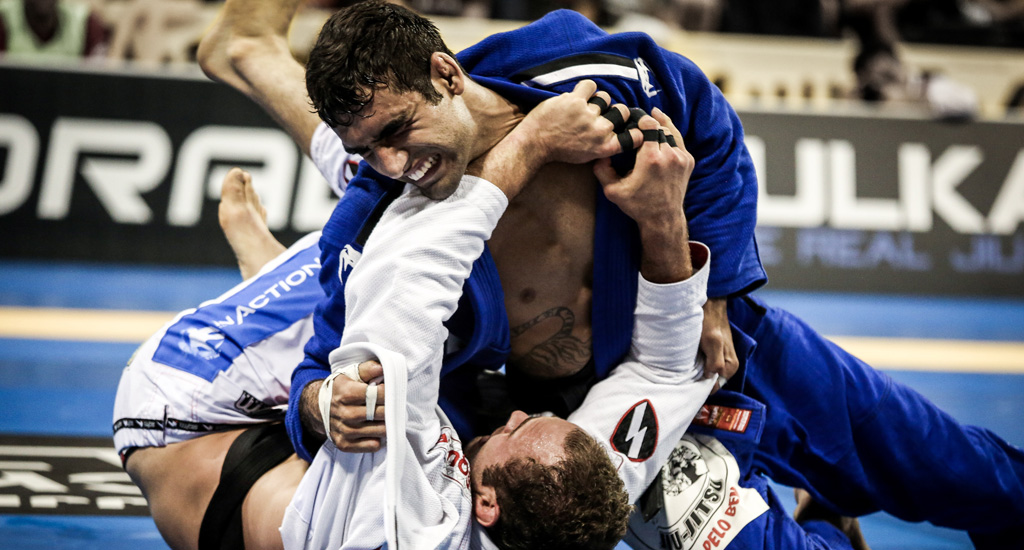
Cover image: Leandro Lo competing at IBJJF Worlds, via BJJ Heroes.