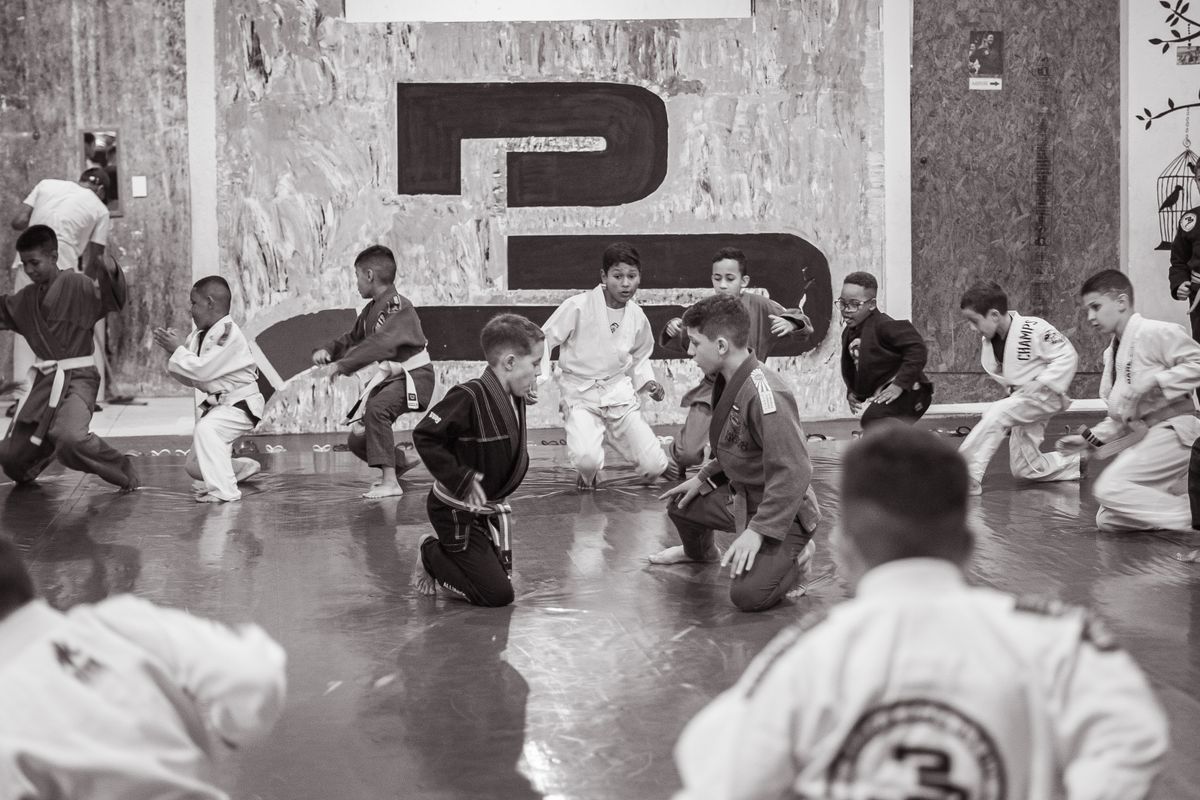
Walk into almost any BJJ academy in the evening and you'll see something you won't find in most sports. The 6 pm kids' class files off the mats, high-fiving on their way out, and the adults filing on include a college student, a nurse coming off shift, a software engineer in his forties, and a grey-haired purple belt who started at 55 and has no intention of stopping.
That's not a coincidence. Brazilian Jiu-Jitsu is built around leverage, timing, and problem-solving rather than raw athleticism, which is why it earned the nickname "the gentle art." You don't need to be young, strong, flexible, or coordinated to start. You just need to keep showing up, and what you get out of it changes with who you are and where you are in life.
Here's what BJJ offers at every stage, and what the research actually says.
For kids: discipline that doesn't feel like discipline
Ask any parent why they put their child in martial arts and "discipline" usually comes up first. The interesting part is that the research backs the intuition up.
A University of Surrey study of 240 primary school children found that even a short 11-week martial arts course measurably improved children's self-regulation — the ability to manage impulses, emotions, and attention — and reduced symptoms of conduct problems. Earlier work on school-based martial arts programs found the same pattern: kids who trained showed better self-control, and those gains carried over into the classroom.
BJJ is especially good at this, and the mechanism isn't mysterious. On the mats, a child learns that:
- You can't skip the boring parts. The cool submission only works after you've drilled the grip, the angle, and the setup a hundred times. Effort now buys skill later — a lesson that transfers directly to homework and everything after it.
- Losing is information, not catastrophe. Every kid taps in training, constantly, and then gets back to work. Learning to lose small, stay calm, and try again is arguably the single most useful thing a child can practice.
- Rules protect everyone. You control your strength, you respect the tap, you look after your partner. That's discipline as care for other people, not just obedience.
And because it's wrestling with your friends rather than standing in lines doing forms, kids genuinely want to come back. The discipline sneaks in while they're having fun.
For adults: learning to think under pressure
Here's the thing nobody tells you before your first class: the hardest part of BJJ isn't physical. It's staying calm and thinking clearly while a resisting person is actively trying to fold you in half.
Psychologists call the broader principle stress inoculation — controlled, progressive exposure to stress builds resilience to future stress. Under pressure, most people's thinking narrows: working memory shrinks, vigilance drops, and you stop seeing options that are right in front of you. Training that repeatedly puts you in manageable stress and asks you to solve problems anyway is one of the most reliable ways to widen that window.
BJJ is essentially a stress-inoculation lab with a belt system. Early on, getting stuck under side control triggers genuine panic — racing heart, shallow breathing, flailing. Six months later, the same position is just a puzzle: frame here, breathe, wait for the weight shift, escape. You have literally trained your nervous system to downgrade "emergency" to "problem."
That skill leaks into the rest of your life. The tense meeting, the family crisis, the deadline that lands at 4 pm on a Friday — they trigger the same physiology as being mounted, and you've rehearsed staying composed through worse. Research on BJJ practitioners reflects this: one study of lifelong skills learned through BJJ found large majorities of adults reporting improved confidence, reduced anxiety, better mood, and greater mental flexibility. Work with veterans and first responders has gone further, with a scoping review finding meaningful improvements in post-traumatic stress, anxiety, and depression among participants in structured BJJ programs.
There's also the simpler mental benefit: while someone is hunting your neck, you cannot think about your inbox. For an hour, the noise stops. Many people find that hour is the best stress management they've ever had — we covered a related angle in why BJJ is great for weight loss, because the stress relief and the fitness feed each other.
For the over-40s and beyond: the sport that ages with you
Most sports quietly push you out as you get older. BJJ does the opposite — it rewards exactly the things age gives you: patience, efficiency, and guile. The gyms are full of people who started in their forties and fifties, and the sport's own competition structure acknowledges it with masters divisions so a 50-year-old never has to test themselves against a 25-year-old unless they want to.
Physically, it checks the boxes that matter most as you age. Grappling is weight-bearing, resistance-based exercise, and resistance training is one of the best-evidenced ways to maintain bone mineral density in older adults. It constantly challenges balance, hip mobility, and the ability to get up off the floor — which sounds trivial until you learn that falls are a leading cause of serious injury later in life. A sport that has you standing up from the ground fifty times a class is, among other things, fall-prevention training in disguise.
Just as important is what it does for your head and your calendar. BJJ gives older practitioners a skill to keep learning (novelty and problem-solving are exactly what aging brains need), a built-in community across generations, and a reason to stay consistent. The training does need to be managed more carefully — more drilling, choosier rolling, more recovery — and we've written about that in strength training for BJJ and injury prevention and how often you should train per week.
For people who "aren't athletes"
This might be BJJ's best-kept secret: it is one of the friendliest sports in existence for people who were never sporty.
Because leverage beats strength, the smaller, weaker, older, or less athletic person isn't just tolerated — the entire art was built for them. Helio Gracie developed his system precisely because he was too frail for his brothers' judo. If you're overweight, BJJ will meet you where you are and change your body along the way. If you're small, you'll learn that technique is a great equalizer. If you're shy, you'll discover that it's hard to stay strangers with someone after you've spent a round trying to strangle each other; the mats produce friendships with unusual speed.
Progress is also unusually visible for a "non-athlete." You don't need to win anything. Surviving a round you would have lost last month, hitting your first sweep on a bigger partner, earning a stripe — the milestones come steadily if you show up. If you're curious what the beginning actually looks like, here's what to expect in your first month of BJJ.
The common thread
Strip away the age groups and the reasons converge on the same three things:
- A skill you can improve forever. There is no ceiling. Black belts twenty years in are still learning, which means boredom — the killer of most exercise habits — never really arrives.
- Pressure in safe doses. Kids get it as losing-and-trying-again; adults get it as composure training; older practitioners get it as proof they're still capable. Everyone leaves a little harder to rattle.
- A community that expects you back. Training partners notice when you're gone. For a species that struggles with consistency, that might be the most powerful feature of all.
Whatever gets you through the door — a kid who needs an outlet, a stressful job, a doctor's warning, plain curiosity — the mats don't care how old you are or what shape you're in. Find a gym with a good beginner program, take the trial class, and give it an honest month.
And once you're training, the fastest way to improve at any age is the same: consistent, deliberate repetition. That's exactly what DrillBuddy is built for — log your drills, track your sessions, and watch the consistency stack up.
This article is for general information and isn't medical advice. If you have a medical condition, are pregnant, or are starting a new sport after a long break, check with a physician first.
Sources: Traditional martial arts can improve self-regulation in school children (University of Surrey via News-Medical), Promoting self-regulation through school-based martial arts training (ScienceDirect), Martial arts training as a psychological self-regulation intervention (Frontiers in Psychology), From Mat to Mastery: Lifelong Skills Learned through Brazilian Jiu-Jitsu (European Journal of Sport Sciences), BJJ for veterans and first responders: a scoping review (The Sport Journal), Under Pressure: Stress and Decision Making (Association for Psychological Science), Resistance training and bone mineral density in older adults: systematic review (PMC).